The field drew a line
at age five.
Families have been paying for that line ever since. The 2016 dissertation, published in 2017, found that maltreatment or a break in primary caregiving after age five was tied to more substantial attachment difficulty — not less. The gate was never closed.
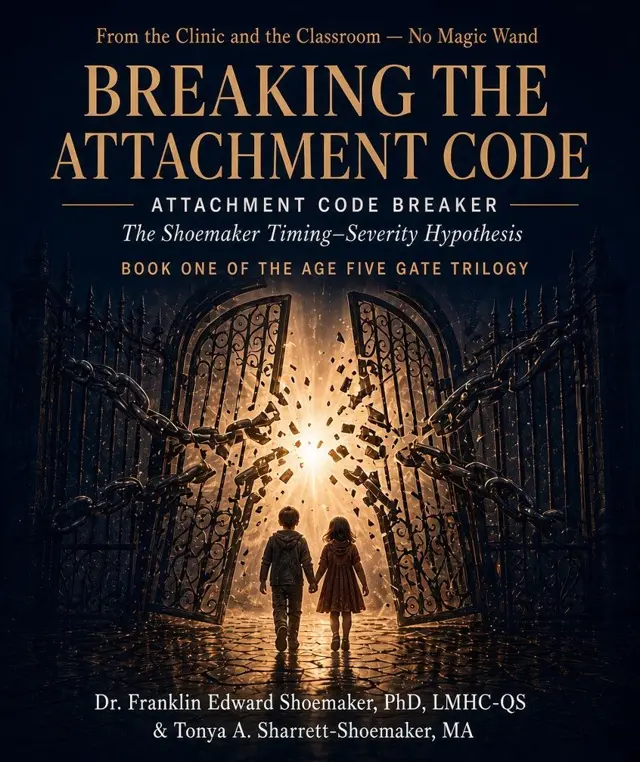
Breaking the Attachment Code
Original: drradtheattachmentcodebreaker.substack.com/p/breaking-the-attachment-code-the
How Child Maltreatment Fuels Attachment Difficulties in Children Ages 5 and Older. The research that launched Dr. RAD™ The Attachment Code Breaker™.
“When I defended the dissertation in 2016, I knew the finding was not small. I did not yet know how fast it needed to leave the library and reach the people holding the child. Clinicians. Adoptive and foster parents. Educators. Advocates.”
The study was later published with Lorraine T. Benuto in Children and Youth Services Review (2017). Foster and adoptive parents, N = 223, reported on children who had lived through maltreatment, a break in primary caregiving, or both. The measure was the Attachment Disorder Assessment Scale–Revised. Two between-groups ANOVAs asked the timing question: before or by age five, versus after age five.
Early trauma is not mild. Later trauma is not lesser.
The result cut the old gate. Children older than five when the maltreatment or the caregiver disruption hit showed more substantial attachment difficulty than children who had those experiences by or before age five. A bond that had started, then broke in the school years, often came back as the heavier file.
Breaking the Attachment Code brings that research into the room. Facts. Focus. Fire. The facts are the dissertation. The focus is what actually drives the difficulty after maltreatment, not the behavior chart taped over it. The fire is the refusal to call a school-age child past the window.
The arc is SNAPPED. SHIFTED. SOLID. A post-five break often looks snapped because survival circuitry has overridden a bond that had begun. The day on that arc is ZAP: Zero-in on when the bond broke, not only on what the child did at 3 p.m. Activate the truth the nervous system can hear: the adult stays. Propel one move finished the same afternoon.
Tonya carries the finding into the classroom: the post-five child often arrives as a referral, a shutdown, or the student nobody can reach by lunch. The behavior is the message. Franklin carries it in the clinic: safety first for every child, and deeper relational repair when the break came after five, because that child already learned that adults can leave.
This book is for the adult who has been told it is too late after five. It is not. The gate was never closed.
Later Trauma, Deeper Wounds
Original: drradtheattachmentcodebreaker.substack.com/p/later-trauma-deeper-wounds-phd-insights
The results the system did not want. When safety is built and then ripped away after five, the wound is not milder. It is deeper, more violent, and more resistant than the cutoff predicted.
Volume II develops the theoretical reading — later trauma, deeper wounds — because a mean difference is not yet a mechanism. Betrayal after use is not the same injury as never having been held: after five, the child can now represent the rupture, the system can now mislabel it, and the adult can be exhausted past repair capacity.
The full article is reserved for Sponsor Lifetime Members of the Dr. RAD™ Substack.
Beyond the Age Five Gate
Original: drradtheattachmentcodebreaker.substack.com/p/beyond-the-age-five-gate-predispositional
Predispositional and Generational Trauma, F94.1 and F94.2, and Algorithmic Substitute Caregivers.
Book One asked when the wound landed. Book Three asks what walks through that open gate now: predisposition, generational trauma, the public criteria for reactive attachment disorder and disinhibited social engagement disorder, and the screen that has started acting like a substitute caregiver.
This is a clinical-educational operating document. It is not individual therapy, legal advice, an IEP determination, a custody opinion, or a magic wand. Diagnostic language tracks the public structure of DSM-5-TR criteria for RAD (313.89 / F94.1) and DSED (313.89 / F94.2), summarized for educational comparison only. SSI-MR is not presented as a normed psychometric test.
The arc is still SNAPPED. SHIFTED. SOLID. A post-five break, a generational loop, or a screen that regulates the child instead of a person can all look snapped. The day is still ZAP: Zero-in on timing, predisposition, and who is actually doing the caregiving, including the device. Activate the truth the nervous system can hear: a person stays. Propel one move finished the same afternoon.
Credentials stated exactly: Franklin E. Shoemaker holds a PhD in psychology and is a Florida Licensed Mental Health Counselor and Qualified Supervisor — not a Florida licensed-psychologist credential. Names and scenes are composite unless a person has explicitly released a story.
The Shoemaker Timing–Severity Hypothesis
Why attachment collapse after age five still counts — and why later rupture can run louder than the cutoff allowed.
Among children already past early childhood, the timing of maltreatment and of primary-caregiver disruption is not a background detail. It is a variable associated with the severity of attachment difficulty as reported by the caregiving adult. A rupture that lands after safety has been built is not automatically milder because the calendar says the sensitive period has closed.
The child did not become a different species at the fifth birthday. The file did.

What it is not
- Not a claim that early harm is trivial. Early rupture remains foundational.
- Not a new name for RAD. RAD and DSED (ICD-10 F94.1 and F94.2) have criteria, floors, and limits.
- Not a verdict on a child. Predisposition is vulnerability, not destiny.
- Not a license to treat an instrument as a finding it was not built to produce. The 2017 summary used the ADAS-R as a caregiver-report measure. SSI-MR is not a normed test.
II · The four axioms
Timing is not a footnote
When the rupture landed is a variable that moves the outcome. Age is a clock that keeps running, not a gate that ends the construct.
Severity is not a mood
Caregiver-reported severity is a score with a rater, a window, and a ceiling — not a bad week that will pass by Thursday.
Predisposition is not an excuse
Vulnerability may be discussed. Never as a verdict. Epigenetics is not a curse.
Caregivers are not extras
They write, repeat, and rewrite the attachment code. They are inside the mechanism.
III · Split the constructs or fail the work
| Construct | What it names |
|---|---|
| Attachment classification | What the pattern is — secure, avoidant, ambivalent, disorganized. Pattern is not loudness. |
| Caregiver-reported severity | How loud the difficulty is. The variable the 2017 study scored. |
| Compliance | What the child performs. Performance can hide or mimic safety. |
| Felt safety | What the child experiences. Whether the body will use the adult. |
IV · The core study: 2016 defended, 2017 published
After the gate, severity was not smaller. It was larger. Limits stated with the finding: it is a caregiver-report study in a foster/adoptive sample; the timing split is coarse (a gate test, not a dose curve); “more substantial” is a group contrast, not a claim about every child; and the study does not convert ADAS-R scores into a DSM-5 or ICD diagnosis.
V · Why later can run louder
The child can now represent the rupture.
After five, the child can narrate, compare, and keep a ledger. “You said this was home” is available as a sentence.
The system can now mislabel the rupture.
ADHD. ODD. Mood. “She’s eleven; this is behavior.” Each name can be locally true and still miss the timing variable.
The adult can now be exhausted past repair capacity.
That adult is not “unskilled.” That adult is inside the mechanism.
A feed can soothe. A feed cannot return in twelve seconds as a person.
Plate 01 · The method
- 1 · Split constructs
- 2 · Time the harm
- 3 · Name severity, not RAD
- 4 · Protect the adult
- 5 · Record the ceiling
- 6 · Keep the file open
Plate 02 · Snapped, Shifted, Solid — stages of work, not identities for a child
Snapped
Fear Engine running. Seeking gone or check-back gone. Adult jaw hot. The feed answers first.
Shifted
Limit if needed. Twelve-second return. Three-minute hinge. One observation line.
Solid
Six months: one figure still there. Eighteen months: use or check-back holds. Staffing can still be short.
Stop
- Treating the age-five sentence as a statute.
- Closing attachment files because the child has a later label.
- Using RAD as a slur, a destiny, or a funding code that expires at kindergarten.
- Collapsing compliance into safety.
- Leaving the caregiver outside the mechanism, then blaming the caregiver.
- Speaking about genes as if they were a closed court.
- Scoring instruments outside their design.
Start
- Time the harm. Write the dates.
- Measure severity as severity. Name the rater, window, and ceiling.
- Keep the four constructs split in every note, IEP conversation, and court letter.
- Put the adult back inside the mechanism. Twelve seconds is a unit.
- Leave the file open.
Later harm still moves severity. The file does not close.
XI · One argument across three volumes
Breaking the Attachment Code
The 2016 dissertation in published form. The numbers that refuse the cutoff.
Later Trauma, Deeper Wounds
The results the system did not want.
Beyond the Age Five Gate
Predispositional and generational trauma. F94.1 and F94.2 after the cutoff. Algorithmic substitute caregivers.
Source: Shoemaker, F. E., & Benuto, L. T. (2017). Examining the relationship between child maltreatment and severity of attachment difficulties among children five years of age and older. Children and Youth Services Review, 75, 35–41. doi.org/10.1016/j.childyouth.2017.02.018. The brief is not a DSM specifier and is not a treatment protocol. The original page includes the 12-page Plate 00 PDF with the Rigor Protocol.
Snapped → Shifted → Solid™
Original: cool-sundae-38d075.netlify.app
A clear, hope-filled roadmap for healing attachment trauma and Reactive Attachment Disorder — forged from 33+ years of frontline clinical work, lived adoptive parenting, doctoral research, and faith-integrated practice. It turns fragmented stories into whole, redeemed ones.
- Elevating Trauma to Trust
- TF-CBT
- Therapeutic Parenting
- Adoption Competent
- Biblical Integration
The Cornerstone Model — three stages, one redeemed story
Snapped
Recognizing and cracking the hidden codes of unresolved trauma, maladaptive survival patterns, and insecure relational templates. The unseen becomes seen — and what is seen can finally be changed.
Shifted
Rewiring those patterns through evidence-based interventions, co-regulation, therapeutic parenting, sensory strategies, and biblical truth. New neural pathways. New, secure bonds.
Solid
Secure attachment, emotional regulation, resilience, and an empowered identity that can withstand life’s storms. Not merely coping — healed, connected, and thriving.
Crack it. Shift it. Own it.™
Crack it.
Fearlessly identify, confront, and break the root attachment codes and trauma loops that have dictated responses, relationships, and self-perception.
Shift it.
Apply TF-CBT, therapeutic parenting, co-regulation, honest narratives, and biblical principles to create new neural pathways and secure bonds.
Own it.
Step into God-given authority over your story, and build a solid foundation of trust, purpose, and generational health.
The Sacred Mission — Elevating Trauma to Trust.
We don’t erase the past — we redeem it. Through compassionate assessment, safety planning, relational repair, structure balanced with nurture, honest adoption and trauma narratives, and the integrating power of biblical truth, we elevate the deepest pain of child maltreatment, complex trauma, and disrupted bonds into the security of trust — trust in self, in safe relationships, and ultimately in a loving God. Families move from survival mode and disconnection into connection, resilience, purpose, and legacy.
Break the cycle.
Breaking intergenerational cycles of pain and empowering secure attachment so individuals and families can experience the freedom and connection they were created for.
Activate the framework.
Snapped → Shifted → Solid™ activated through Crack it. Shift it. Own it.™ — powered by clinical insight, TF-CBT, adoption-competent care, therapeutic parenting, and biblical counseling.
Rewrite the legacy.
Lives and families no longer controlled by the past — Snapped (awakened and freed), Shifted (healed and realigned), and Solid (resilient, purposeful, legacy-building).
The Signature Ethos — Facts. Focus. Fire.
Facts
Grounded in clinical research, the neuroscience of trauma and attachment, biblical truth, and documented outcomes from thousands of hours in therapy rooms and classrooms. No hype. No fluff.
Focus
Cuts straight to what matters for hurting kids, overwhelmed parents, dedicated educators, and clinicians. Immediately usable at the kitchen table, in the classroom, or in the therapy office.
Fire
Delivered with passion, urgency, and conviction because lives and generations are on the line.
Together, Franklin and Tonya address root-level trauma, disrupted attachment, and the whole person — mind, brain, body, relationships, and spirit — so individuals and families don’t just cope… they heal, connect, and thrive.
The story is still yours to rewrite. All glory to God.