Learn to read
the code.
For parents, adoptive and foster caregivers, teachers, clinicians, child welfare professionals, and faith leaders. Trainings, workbooks, devotionals, and cheat sheets built from the clinic and the classroom.
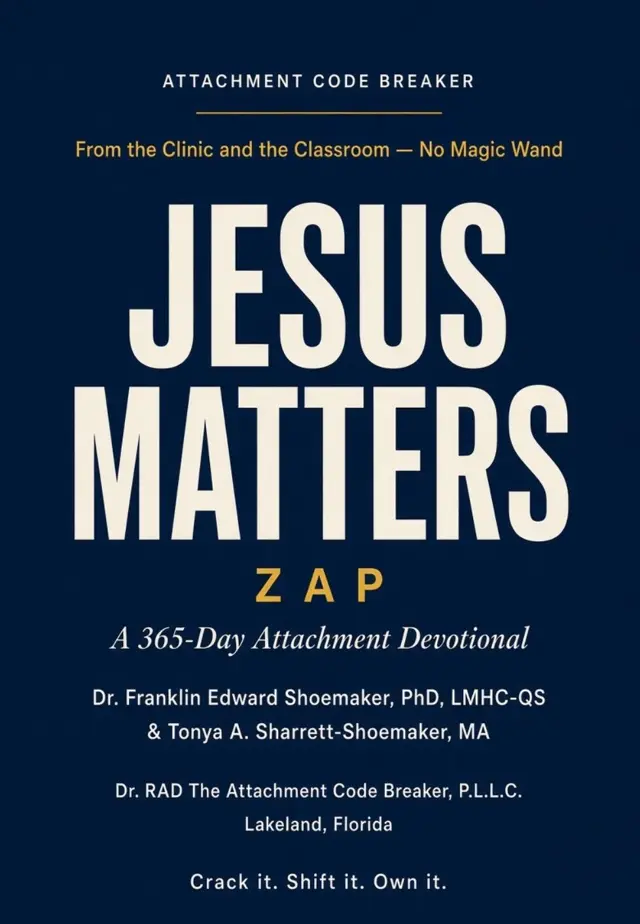
Jesus Matters ZAP
Original: jesusmatterszaptraining.netlify.app
A 365-Day Attachment Devotional: Training Presentation. Dr. Franklin Edward Shoemaker, PhD, LMHC-QS, TF-CBT, Adoption Competent, and Tonya A. Sharrett-Shoemaker, MA, Certified Educator. Crack it. Shift it. Own it.
Jesus matters in the twelve seconds after the limit, not only on a Sunday stage.
No performance of calm. One daily sequence that protects the adult nervous system and keeps a shared world on offer. Crack the pattern. Shift the timing. Own the return.
“As a father has compassion on his children, so the Lord has compassion on those who fear him.” — Psalm 103:13 · “We love because he first loved us.” — 1 John 4:19
Attachment is not a theory about weakness. It is a theology about design.
Dedication
To every child who ever wondered if they were worth keeping: You are. You always were. Jesus knew your name before you drew your first breath. To every parent who said yes when it was hard: your yes was sacred. Heaven noticed. To the families still in the middle of the story: keep going. The Solid is coming.
Prologue — She was seven years old, and she had not been held in three years.
She sat in the corner of the therapy room, back against the wall, eyes tracking the door. She was not angry. She was watching. Fourteen months of consistent, patient, grace-filled relational presence, and then the day she reached. The hand went out. The arms came around her. Something ancient and designed clicked into place.
Jesus is not incidental to healing. He is the center of it.
The science lineage — how we are loved shapes the organ with which we love
| 1969 | Bowlby — attachment system & the internal working model |
| 1978 | Ainsworth — the Strange Situation; secure base & safe haven |
| 1990 | Main & Solomon — the disorganized / fearful pattern |
| 2006 | Perry — the brain heals in the order it was built |
| 2007 | Purvis & Cross — TBRI: empowerment, connection, correction |
| 2009 | Hughes — PACE: Playfulness, Acceptance, Curiosity, Empathy |
| 2012 | Siegel — interpersonal neurobiology |
| 2014 | van der Kolk — the body keeps the score |
Scripture has always been an attachment document
“God is our refuge and strength, an ever-present help in trouble.” Psalm 46:1
“Come to me, all you who are weary and burdened, and I will give you rest.” Matthew 11:28
“The Holy Spirit… will teach you all things and will remind you.” John 14:26
The Father runs to the prodigal before the son can finish his speech. Luke 15:20
The Framework™ — one journey, three seasons
Snapped
The wound named. The far country, the pit, the wilderness. Psalm 22 · Psalm 46:1 · Luke 15:13–17
Shifted
Healing in motion. The turning, the return, the new creation. Romans 12:2 · Ezekiel 36:26 · 2 Corinthians 5:17
Solid
Consolidated security. The Promised Land, the inheritance, the sending. Ephesians 3:17–18 · Matthew 7:24 · Deuteronomy 7:9
Every day, six parts: Zero-in · Activate · Propel
Scripture
“See, I am doing a new thing!… I am making a way in the wilderness and streams in the wasteland.” Isaiah 43:19
Zero In
Felt safety does not begin with the absence of wilderness. It begins with the presence of a Guide who is not afraid of it.
Activate
I am safe enough in His presence to take one step forward.
Propel
Post “Jesus is making a way” where you’ll see it. Each time: breathe slowly, say it aloud.
Prayer
“Make the path visible enough for one step. I trust You with the rest. Amen.”
Journal
What feels most like “wilderness” in your life or family right now?
Ten to fifteen minutes. One year. Use it individually, as a couple, as a family, in a small group, or in clinical settings as a supplemental resource. Appendices include the DR RAD SSI-MR v9.4.4™ sequence (physiological regulation → relational re-engagement → meaning), the Engine 9 Research Cross™, a phase guide, and an interactive reflection.
Jesus Matters. He is our Secure Base. He is our Safe Haven. He is our Solid.
SNAP→SOLID Training — The Complete Codebreaker Series
Original: drradtheattachmentcodebreaker.substack.com/p/snapsolid-training-the-complete-codebreaker
For every adult who stays. The field drew a line at age five. Families have been paying for that line ever since.
This workbook is for the parent who is still in the kitchen at 2 a.m. For the adoptive family that said yes — and keeps saying it. For the foster home that takes the night placement. For the case manager, investigator, and GAL who refuse to close the file because of a birthday. For the teacher, ESE specialist, counselor, and administrator who can tell compliance from felt safety. For the coach, mentor, pastor, and youth worker who will still be there on Monday. And for the child who did not create the loop.
Participant Workbook
The Age Five Gate Trilogy is the research spine of Dr. RAD | The Attachment Code Breaker™.
Facilitator Guide
Companion to the Participant Workbook and the premier training deck. Authors: Dr. Franklin Edward Shoemaker, PhD, LMHC-QS, and Tonya A. Sharrett-Shoemaker, MA. Lakeland and Dade City, Florida.
Premier SNAP→SOLID Training
A cinematic thirteen-module training for parents, adoptive parents, foster caregivers, child welfare professionals and educators: the Age Five Gate Trilogy, the Shoemaker Timing–Severity Hypothesis, Snapped → Shifted → Solid, hope, faith and TF-CBT.
Thirteen modules. One code. Decode the patterns · Break the cycles · Transform the future. Presenter notes, a chapter index, and full-screen mode are built into the deck.

| # | Module | Focus |
|---|---|---|
| 01 | Breaking the Attachment Code | The Age Five Gate Trilogy · Book One |
| 02 | Later Trauma, Deeper Wounds | The Age Five Gate Trilogy · Book Two |
| 03 | Beyond the Age Five Gate | The Age Five Gate Trilogy · Book Three |
| 04 | The Research Spine | One argument, three volumes |
| 05 | After the Gate | The Shoemaker Timing–Severity Hypothesis |
| 06 | Snapped → Shifted → Solid | The Integrated Therapeutic Protocol |
| 07 | The Unresolved Code | Breaking the trauma loops that keep families stuck |
| 08 | Snapped to Solid | Rebooting attachment in families · The Codebreaker Training |
| 09 | SNAPPED → SOLID | Facing the broken code · Living the Zapped life |
| 10 | HOPE SNAPPED | How hope buffers the severity of mental health disorders |
| 11 | Jesus Matters ZAP | A 365-day attachment devotional |
| 12 | PRACTICE | Healing childhood trauma with TF-CBT |
| 13 | More Services ≠ Quicker Results | Why adding more interventions often deepens trauma |
Copyright 2026. All Rights Reserved without written permission. Dr. Franklin Edward Shoemaker & Tonya A. Sharrett-Shoemaker. Training presentation for use by the authors.
The Attachment Code Breaker Cheat Sheet
Decoding behaviors and building secure bonds — because every hard moment is a message from a child learning to trust.
Welcome, adoptive parents. Adopted children often carry invisible “codes” — behaviors shaped by early experiences of loss, trauma, or inconsistency. This cheat sheet equips you with tools to decode these signals and foster secure, loving attachments. Patience is key. Building trust takes time, but consistency and responsiveness will unlock deeper connections.
01 · Understanding attachment styles — the foundation codes
Secure
Child feels safe, explores freely, seeks comfort from you. Tip: aim here by being reliable and warm.
Anxious-Ambivalent
Clingy, fearful of abandonment, hard to soothe. Decoded: signals unmet needs — respond with reassurance, not dismissal.
Avoidant
Distant, self-reliant, avoids closeness. Decoded: hides vulnerability — gently encourage emotional sharing without forcing.
Disorganized
Erratic, fearful, or aggressive. Decoded: often from trauma — seek professional help; provide structure to rebuild safety.
Pro tip: observe patterns over weeks. Journal behaviors to spot trends.
02 · Decoding common behavior codes
| Code | Decoded | Breaker strategy |
|---|---|---|
| Excessive clinging or tantrums | Fear of loss — “Will you leave me too?” | Validate feelings (“I see you’re upset; I’m here”). Use routines to predictably show you’ll return. Avoid punishment; offer hugs or calm-down spaces. |
| Withdrawal or independence | Self-protection — “I can’t rely on anyone.” | Initiate gentle play or one-on-one time daily. Praise small trusts; don’t push too hard. |
| Testing boundaries (defiance or lies) | Checking safety — “Can I trust your love?” | Set clear, consistent limits with empathy. Explain rules lovingly; follow through calmly. Reconnect after conflicts. |
| Regression (bedwetting, baby talk) | Seeking nurture missed earlier — “I need to feel like a baby again.” | Meet the need regressively if appropriate. Provide comfort items; consult therapists for ongoing issues. |
| Hyperactivity or aggression | Overwhelm or unresolved trauma — “I don’t feel in control.” | Create sensory calm-down routines (e.g., deep pressure hugs). Teach emotional words; model calm responses. |
Behind every behavior is a question. Your consistency is the answer.
03 · Unlock keys — master strategies to build secure bonds
Establish predictability — routines = security
Consistent meal, bedtime, and play schedules signal “You’re safe here.”
Foster physical closeness
Eye contact, cuddles, and skin-to-skin (e.g., swimming, massages). Start small; respect boundaries while inviting connection.
Responsive caregiving
Respond promptly to hunger, fear, or sadness. This builds trust: “My needs matter.”
One-on-one time · 10–20 min daily
Undivided attention. Play games, read, or talk — no distractions.
Honor their history
Discuss origins openly and age-appropriately. Validate grief: “It’s okay to miss your first family.” Use lifebooks or stories.
Set loving boundaries
Be firm yet kind. Boundaries say “I care enough to guide you.”
Emotional coaching
Name feelings (“You seem angry — let’s talk about it”). Teach coping skills like deep breathing.
Self-care for parents
Your attachment style matters. If you’re stressed, seek support. Secure parents raise secure kids.
Bonding activities
Baby-wearing for toddlers, co-sleeping safely, or family rituals like nightly gratitude shares.
Professional tools
Consider attachment assessments or therapy. Resources: AdoptUSKids.org, AttachmentProject.com.
Every child’s code is unique. Celebrate small wins, like a voluntary hug or shared laugh. If progress stalls, consult experts — you’re not alone.
This cheat sheet is for informational purposes and is not a substitute for professional mental health advice. Share freely, but credit the source.
Trauma Essentials
Original: traumaessentials.netlify.app
Trauma is not a trend, and it is not a filter. It is wiring. It changes how a child thinks, feels, acts, and connects. Left unread, it can run for years. Cracked, it can shift.
If you are a parent in the chaos, a teacher dodging the daily explosion, a clinician trying to keep the file honest, or a faith leader who just stepped into the mess, this is the start. The difference between stuck-in-survival and a bond that holds is not trying harder. It is reading the code.

What trauma does
Early maltreatment, neglect, loss, foster ping-pong, adoption whiplash, and chronic stress do not only leave a memory. They train the nervous system. The alarm stays hot. The shutdown stays close. Connection starts to feel like a test the child can fail.
File: 2016 dissertation · published 2017. Children who were older than five when maltreatment or a primary-caregiver break hit showed more substantial attachment difficulty than children who had those experiences by or before age five. Early trauma is not mild. Later trauma is not lesser. The age-five gate was never closed.
Timing changes severity.
The child in front of you.
Do not write the school-age child off.
A snapped child is not choosing the storm — read the code under the mask
It is a test: come close, then prove you will leave.
The shutdown is armor.
The explosion is a nervous system that cannot find the brake.
The mask is performance, and performance is not secure attachment.
Judgment keeps the loop. A trauma read interrupts it. Escalation during repair is not always failure. Sometimes it is the old code meeting an adult who stayed.
Zero-in on one fact.
When the bond broke. What the behavior is saying. Not ten problems. One.
Activate one truth.
The adult stays. Jesus does not shame the wound. Love here is not a test.
Propel one move.
A sentence said out loud. A repair before supper. If it cannot be done today, it is not a Propel step.
Does not heal
- Try harder
- Ignore it
- Medicate the bond away
- Call the child a villain
Does heal
- Stability
- Co-regulation before correction
- A truthful story about the loss
- An adult who does not leave when the test arrives
If you are new
Start with the timing.
Ask when the maltreatment or the caregiver loss happened, not only whether it happened.
Then Zero-in.
Then one Propel step.
Then come back tomorrow.
You are not failing. The code was never cracked for you. It is cracked now.